
Traditions
Native American Wedding Traditions
Many Native Americans desire a wedding which reflects their Indian heritage. You must understand where relatives and ancestors may have originated from to plan the wedding reflecting your heritage.We have included certain traditions and customs that reflect specific tribes in the United States. Please feel free to contact us with your comments, and any other traditions which you would like us to include.
Culture and Spirituality
Native American culture is composed of many tribes, each with distinct traditions and customs. It is difficult to characterize any aspect of a wedding as being "Native American". Some traditions are common to many tribes, while others are unique.Most Native Americans believe that in the universe there exists the Great Spirit - a spiritual force that is the source of all life. The Great Spirit is not pictured as a man in the sky but it is believed to be formless and to exist throughout the universe. The sun is viewed as a manifestation of the power of the Great Spirit.
Some Native American wedding ceremonies are informal, while others are quite formal. When they were not small and information, these events were solemnized with feasts and merrymaking. Evening is the traditional time for the ceremony to occur.
Water is used as a symbol of purification and cleansing. The bride and groom have a ceremonial washing of hands to wash away past evils and memories of past loves.
Many different tribes incorporate different traditions and customs meant to combine two lives into one and their roles in their new family. These traditions also reflect a respect and appreciation of the elders and the tribal wisdom being passed down.
Pueblo Traditions
The Pueblo bride wore a cotton garment tied above the right shoulder, secured with a belt around the waist. Another tradition involves the wedding vase, which has been part of this tribe's traditions for centuries. This vase is made with two spouts and one handle at the top. Each of the spouts represents the bride and groom's lives, with the handle serving as a bridge to unite them. The groom's parents are the ones providing this vase for the ceremony. On the day of the wedding, the vase is filled with holy water and given to the bride. She will drink from one side, and the groom will drink from the other spout. The ceremony of drinking from the wedding vase carries a significance similar to the exchange of wedding rings.
This ceremonial pottery is considered sacred, so it should only be made and given as a gift among tribal members.
(Source: Wedding Vases – PuebloDirect.com)
Navajo Traditions
These wedding ceremonies are considered very private, to be witnessed only by close family and friends. No photographs are permitted. The ceremony begins with the groom, his family, and friends entering the Hogan, the traditional home of the Navajo, clockwise. His family and friends will sit to the left of him, while the bride's family and friends will sit to the right of her.
Once everyone is in the Hogan, then the ceremony will open with a prayer. Then a basket of prepared corn mush, a mix of white cornmeal to symbolize the male and yellow cornmeal for the female) is blessed using corn pollen before a line is made from est to west and then back to east. Another line is made from south to north and then back to the south. The corn mush is then outlined with corn pollen in a circular shape clockwise, beginning from the east before completing the entire circle.
Water is then poured into a gourd given to the couple for traditional handwashing, symbolizing purity and cleansing. Then the groom eats a pinch of the corn mush from each direction, starting with the east, and the bride follows suit. Finally, they take a pinch from the middle of the corn mush. This basket of corn mush and all the directions are meant to symbolize all the different stages of life’s journey. Then the groom’s family finishes any of the leftover corn mush, while the basket remains stationary. Once it is finished, the wedding blessing is given by the tribal elders.
The next day, a feast is typically held, where the bride’s family provides the food. Any leftovers are given to the groom’s family, which completes the wedding ceremony, joining the couple for life.
(Source: Culture Corner: Traditional Navajo Wedding - Northeastohioweddingsmagazine)
From Native American Courtship & Marriage:
"Native American legends and myths have existed for thousands of years and are still relevant today. Many stories are moral tales about humankind's relationship with the natural world, as well as several inspiring and poetic tales about love and the ritual of courtship. Indian poems had their roots in the songs and chants of tribal life. The Indians wrote songs and poetry for practical purposes as well as to deal with the invisible forces in their lives. They helped the people to conduct their lives honorably and assisted them through times of great emotion and need". There are many moving stories in this book about marriage, courtship and puberty rites and celebrations, including even some suggested recipes!
Northern California Traditions
A custom among the Northern Californian Native Americans*, which was unique to them, is that of half-marriage and full-marriage.In a full marriage, two kinsmen represented the future bridegroom. After agreeing on a price, in accordance with the family's wealth and social standing, the bridegroom - usually with his father's help - would pay the bride's family. The future social status of the family and the children depended on the price, therefore the bridegroom was willing to pay as much as he could possibly afford.
In half-marriage, the man would pay about half the usual price for his bride. The man would live in his wife's home under her father's jurisdiction. A man might have to half-marry because of a lack of wealth or social standing, or if his father did not approve of his bride. A woman's family might allow her to half marry because they had no sons and needed another man in the family, or if there were Shaman powers in the family. About one in four marriages were half-marriages.
The bride's dress may be woven in symbolic colors: white for the east, blue for the south, yellow (orange) for the west; and black for the north. Turquoise and silver jewelry are worn by both the bride and the groom in addition to a silver concho belt. Jewelry is considered a shield against evils including hunger, poverty and bad luck.
*The tribes of northern California include the Klamath, the Modoc and the Yurok.
Delaware Traditions
A Delaware Native American girl who reached puberty may have had her union prearranged by her parents. Often a couple just lived together as man and wife. To mark the occasion, there was a simple exchange of jewelry, blankets or a belt of wampum to the girl's parents. If the parents accepted the gifts the union was sanctioned.The young bride would wear a knee-length skirt of deerskin and a band of wampum beads around her forehead. Except for fine beads or shell necklaces, the body would be bare from the waist up. If it were a winter wedding, she would wear deerskin leggings and moccasins and a robe of turkey feathers. Her face would be painted with white, red and yellow clay.
Pubelo Traditions
The Pueblo bride wore a cotton garment tied above the right shoulder, secured with a belt around the waist.
Navajo Traditions
White corn meal symbolizes the male and yellow the female. The Navajo combine the two meals into a corn mush and put it into a wedding basket before the traditional ceremony.The Navajo bride was an equal partner to her husband. The couple would share the maize pudding during the ceremony to symbolize the marriage bond.
Hopi Traditions
(special thanks to www.indiansun.com for some of this information)
The Hopi Native girl, after undergoing important rites of adolescence, (usually between the age of 16 and 20) is ready to receive suitors. In former days it was customary to give an informal picnic on the day following an important ritual.If a girl had decided on a youth as a future mate, she would extend to him an invitation to accompany her and would present him with a loaf of qomi, a bread made of sweet cornmeal in lieu of somiviki (maiden's cake). Since this invitation was tantamount to being engaged, boys would only accept the invitation from girls they were willing to marry.
A Hopi young man would propose to a maiden by preparing a bundle of fine clothing and white buckskin moccasins. He would leave the bundle at her doorstep and if she accepted it, she accepted him as her future husband.
Approving the Marriage
If the prospective Hopi bride and groom expected the marriage to be sanctioned by society, there were several restrictions which must be followed. No marriage was allowed within the nuclear family or to someone who was previously married.Once the decision to marry is made by the young couple, the boy goes, after supper, to the girl's home and states his intentions to the girls parents. If approved, he is instructed to return to his home and inform his parents. The girl will grind cornmeal or make bread and take it to the home of her prospective groom. If the mother accepts it, the wedding plans move forward.
Wedding Preparations
The bride returns home to grind more cornmeal, and the groom fetches water and chops wood for his mother. On the evening when these chores are completed, the bride dresses in her manta beads and her wedding blanket. She, with the boy, walk barefoot to his house. She presents the cornmeal to his mother and prepares for a three day stay at his home.For three days prior to the wedding, the bride will rise and grind cornmeal for her mother-in-law. During this period, the groom's paternal aunts visit and "attack" the bride with mud. Her future mother-in-law steps in to protect her.
Consumation of the Marriage
On the morning of the wedding the bride's female relatives brought to the groom's mother's home, the ground corn and piki bread that the bride had prepared.
The females then washed the hair of the engaged couple in a single basin. The hair of the bride and groom was then entwined to signify their lifelong union.
With hair still interwoven the bride and groom walk to the edge of the mesa to witness and pray to the rising sun.
Wedding Attire
They remain at the girl's home until her wedding garment is complete. The garments are woven by the groom and any men in the village who wish to participate. The garments consist of a large belt, two all-white wedding robes, a white wedding robe with red stripes at top and bottom, white buckskin leggings and moccasins, a string for tying the hair, and a reed mat in which to wrap the outfit. (This outfit also will serve as a shroud, since these garments will be necessary for the trip through the underworld.)
Conclusion of the Ceremony
In about two weeks, she will dress in her wedding garments and return to her home where she is received by her mother and relatives. The groom's relatives accompany her and an exchange of gifts are made. During that evening, the groom comes and spends the night at his mother-in-law's. The next day he fetches wood for her, and from then on is a permanent resident in her house.
Algonquin Traditions
Algonquin speaking people include the Cree, the Ojibwa or Chippewa, the Ottawa, the Montagnais, the Naskapi and others.When a young man chooses a mate in the old way, he went with her family (matriarch society). The custom was usually determined by the growing season. In warmer climates, where women would raise crops to support the families, they were considered the providers. In cooler climates where families subsisted on hunting performed by the men, the communities were considered patriarchal.
The Giveaway
In preparation for the Giveaway, the future bride and groom make (or buy) hundreds of gifts. A gift will be given to each person attending the celebration. The type of gifts is dependant upon the talent and financial ability of the couple.
Wedding Prayer
Known commonly as the 'Apache Wedding Prayer', 'Indian Wedding Blessing', and other variants, the following is a prayer commonly recited at weddings in the United States. We have learned from www.wikipedia.org that it is not associated with any particular religion. It was written for the 1950 Western movie Broken Arrow and has no known connection to the traditions of the Apache or any other Native American group. We include this because you may be looking for it.
Now you will feel no rain,
For each of you will be shelter to the other.
Now you will feel no cold,
For each of you will be warmth to the other.
Now there is no more loneliness,
For each of you will be companion to the other.
Now you are two bodies,
But there is only one life before you.
Go now to your dwelling place
To enter into the days of your togetherness
And may your days be good and long upon the earth.
Old Cherokee Wedding Traditions
The Cherokee wedding ceremony is a very beautiful event, whether it is the old fashoned, or 'ancient' ceremony or a modern one. The original ceremony differed from clan to clan and community to community, but basically used the same ritual elements.
Because clanship is matrilineal in the Cherokee society, it is forbidden to marry within one’s own clan. Because the woman holds the family clan, she is represented at the ceremony by both her mother (or clan mother) and oldest brother. The brother stands with her as his vow to take the responsibility of teaching the children in spiritual and religious matters, as that is the traditional role of the ‘uncle’ (e-du-tsi). In ancient times, they would meet at the center of the townhouse, and the groom gave the bride a ham of venison while she gave an ear of corn to him, then the wedding party danced and feasted for hours on end. Venison symbolized his intention to keep meat in the household and her corn symbolized her willing to be a good Cherokee housewife. The groom is accompanied by his mother.
After the sacred spot for the ceremony has been blessed for seven consecutive days, it is time for the ceremony. The bride and groom approach the sacred fire, and are blessed by the priest and/or priestess. All participants of the wedding, including guests are also blessed. Songs are sung in Cherokee, and those conducting the ceremony bless the couple. Both the Bride and Groom are covered in a blue blanket. At the right point of the ceremony, the priest or priestess removes each blue blanket, and covers the couple together with one white blanket, indicating the beginning of their new life together.
Wedding Vases
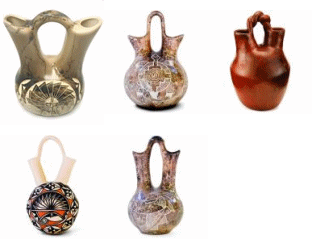 A wedding vase is traditionally used by Native American couples in the Southwest but it is being used increasingly by couples everywhere drawn to the culture's spirituality and reverence for nature, the earth, and the environment.
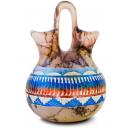 During the ceremony each person drinks from a spout to symbolize both individuality and unity. The Sea and Sky Vase is one-of-a-kind, (shown on the left) hand etched and hand painted in New Mexico. It measures 8" tall and is signed by the artist Geraldine Vail, a Navajo Indian.
It is important to know that these vases are made to hold liquid for a very short period of time. The vase should be emptied and dried promptly after the ceremony and should never be used as a vessel for liquid which will destroy the vase.