
Hindu Wedding Traditions
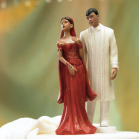 Many Hindu Americans desire a wedding which reflects their native heritage. You must understand where relatives and ancestors may have originated from to plan the wedding reflecting your heritage. We have included many traditions from India and the Hindu religion. Please feel free to contact us with your comments, and any other traditions which you would like us to include. Enjoy!
Wedding Traditions
The Indian culture celebrates marriage as a sacrament (Sanskara), a rite enabling two individuals to start their journey in life together. In a Hindu wedding, the multiplicity of creation becomes possible when the spirit (Purush) unites with matter (Prakriti). The Hindu wedding lays emphasis on three essential values: happiness, harmony, and growth.
The institution of marriage can be traced back to Vedic times. The ceremony should be held on a day in the "bright half" of the northern course of the sun. Months before the wedding an engagement ceremony known as Mangni is held. This is to bless the couple, who are then given gifts of jewelry and clothing by their new family.
Jaimala (Exchange of Garlands)
The couple exchanges garlands as a gesture of acceptance of one another and a pledge to respect one another as partners.
Madhupak (Offering of Yogurt and Honey)
The bride's father offers the groom yogurt and honey as the expression of welcome and respect.
Kanyadan (Giving Away of the Bride)
The father of the bride places her hand in the groom's hand requesting him to accept her as an equal partner. The concept behind Kanyadan is that a bride is a form of the goddess Laxmi and the groom is Lord Narayana. The parents are facilitating their union.
Havan (Lighting of the Sacred Fire)
The couple invokes Agni, the god of Fire, to witness their commitment to each other. Crushed sandalwood, herbs, sugar rice, and oil are offered to the ceremonial fire.
Rajaram (Sacrifice to the Sacred Fire)
The bride places both her hands into the groom's and her brother then place rice into her hands. Together the bride and groom offer the rice as a sacrifice into the fire.
Gath Bandhan (Tying of the Nuptial Knot)
The scarves placed around the bride and groom are tied together symbolizing their eternal bond. This signifies their pledge before God to love each other and remain faithful.
Mangalphera (Walk Around the Fire)
The couple makes four Mangalpheras around the fire in a clockwise direction representing four goals in life: Dharma, religious and moral duties; Artha, prosperity; Kama, earthly pleasures; Moksha, spiritual salvation and liberation. The bride leads the Pheras first, signifying her determination to stand first beside her husband in all happiness and sorrow.
Saptapardi (Seven Steps Together)
The bride and groom walk seven steps together to signify the beginning of their journey through life together. Each step represents a marital vow:
First step: To respect and honor each other
Second step: To share each other's joy and sorrow
Third step: To trust and be loyal to each other
Fourth step: To cultivate an appreciation for knowledge, values, sacrifice, and service
Fifth step: To reconfirm their vow of purity, love family duties and spiritual growth
Sixth step: To follow principles of Dharma (righteousness)
Seventh step: To nurture an eternal bond of friendship and love
Jalastnchana (Blessing of the Couple)
The parents of the bride and groom bless the wedded couple by dipping a rose in water and sprinkling it over the couple.
Sindhoor (Red Powder)
The groom applies a small dot of vermilion, a powdered red lead, to the bride's forehead and welcomes her as his partner for life. It is applied for the first time to a woman during the marriage ceremony when the bridegroom himself adorns her with it.
Aashirvad (Parental Blessing)
The parents of the bride and groom give their blessings to the couple. The couple touches the feet of their parents as a sign of respect.
Menhdi (Henna Ceremony)
The traditional art of adorning the hands and feet with a paste made from the finely ground leaves of the Henna plant. The term refers to the material, the design, and the ceremony. It is a tradition for the names of the bride and groom to be hidden in the design, and the wedding night is not to commence until the groom has found both names. After the wedding, the bride is not expected to perform any housework until her Menhdi has faded away.
Mangalasutra (Thread of Goodwill)
A necklace is worn specifically by married women as a symbol of their marriage.
Bengali Wedding Traditions
Adan Pradan
In the presence of a Purohit (priest), the bride and groom, (after approval of each other), their elders (usually parents, grandparents and elder aunts and uncles) sit down together. It is established that the couples are not close blood relatives and have the same status. This occasion is called Adan Pradan. After this takes place the date of the marriage is set according to the Indian calendar. (There are several time periods during which a wedding cannot be held.)
Aashirwad
The Aashirwad is a confirmation of the marriage alliance. It takes place a day or two before the actual wedding in the evening. A priest is present. The ceremony takes place at either the groom's or the bride's home. The door of the entrance is decorated with a string of mango leaves which will stay for a period of one year after marriage. The bride is given a sari. The groom is presented with a ring, gold buttons, and a watch.
Vridhi
On the day before the wedding, the priest will visit the house of the bride and the groom and offer a prayer to the ancestors. This ceremony is called Vridhi.
Dodhi Mangal
On the day of the wedding, early in the morning, before sunrise, the Dodhi Mangal ceremony is held. Eight to ten married women accompany the couple to a nearby pond. They invite the Goddess Ganga to the wedding and bring back a pitcher of water from the pond to bathe the bride and groom. The bride and groom are offered the only food they will eat that day. This meal is fried fish, curd and flattened rice.
The Wedding Ceremony
At the actual wedding ceremony, the groom's father and all the other relatives are present. The groom's mother does not attend. A paternal or maternal uncle gives away the bride. The bride's father and other relatives attend, but her mother does not. It is believed that if the mothers are not present it will protect the bride and groom from the evil eye.
As the groom arrives he is welcomed by blowing conch shells, ringing bells and ululation. The mistress of the house touches the silver plate to the groom's forehead and then the ground, and up to the groom. This is repeated three times, the groom is offered, sweets. Water is then poured on the doorstep of the house as the groom enters.
The priest comes with an idol of God and in the presence of the family and friends the ceremony begins. As a part of the ceremony, there is an exchange of the floral garlands and other rituals. While the ceremony is taking place, dinner may be served. After the ceremony is over, games are played and the couple is kept awake that night by songs, poetry, and jokes offered by the family and friends.
The Mandap Ceremony
The morning after the ceremony the bridegroom applies vermilion on the bride's forehead. This is a symbol of her marital status. At the Mandap ceremony, in the presence of the priest, they then worship the Sun God. They seek the blessings of all elders and set out to the groom's house.
The Arrival at the Groom's House, and The Bou Bhat Ceremony
On arrival at the groom's house, women pour water on the ground under the vehicle which they have traveled and the couple exit the vehicle.
In some houses, the women wash the feet of the bride with milk and flour before offering sweets and sherbet to the couple. In others, the bride steps into the milk and flour and imprints her soles on the mixture. The bride is then led by the women in the house.
The elders present bless the couple. Ornaments and saris are presented to the bride. She and her groom sit on a wooden plank and the Bou Bhat ceremony begins.
Women blow conch shells, ring bells, and take up wailing. The bride does not eat any food in her in-law's house. That night, the bride wears a new sari. The bedroom is tastefully decorated with flowers. The flowers and clothes come from the bride's house along with the sweets.
The Return to the Bride's House
A few days after the wedding day, the newlywed couple return to the bride's home. The thread which was tied on the bride's wrist by the priest is cut.
Wedding Gifts
Gifts are exchanged between the bride's family and the groom's family before and after the wedding.
Ritual Baths and Attire
A ritual bath of turmeric, oil, and water is applied to both the bride and groom's hair by married women. Both parties wear new clothes. The ritual of wearing conch shell bangles takes place at the bride's house. These bangles are dipped in turmeric water.
Mariam Aziz, one of our readers, tells us that a Pakistani Bride wears red on the day of her wedding because red symbolizes happiness. Another reason why red is worn is because it is bright. No one else wears red that day except the Bride.
Mehandi
Highly exotic, intricate patterns decorating the bride's hands and feet with henna is called Mehandi. It is believed that the deeper the color the stronger is her love for her husband.
Attire
The bridal dress is a sari and the bride dons all the ornaments. Her hair is usually in a bun and covered with a crown and veil. Sandalwood is artistically applied on her face in the design of the crown.
Covering the head during a wedding is a mark of respect to the deities worshipped and the elders present. The ghunghat, which is equivalent to the veil of the Christian bride, is worn by the bride.
It may vary in length, covering not only the head but the shoulders, back and almost down to the waistline. The draping may be done in several ways. The chunri, worn with a ghagra choli, is tucked in at the waist on one end, pleated beautifully around the body and draped delicately over one shoulder.
An odhnis is usually made of silk with a tie-dye pattern. The center of the veil is used as a head covering the ends taken care under the arms and tucked inside the neck of the abhor or chorizo (the upper garment).
The groom will wear a Dhoti, which is an unstitched garment, and a shirt. On arrival at the bride's house, he will change into another similar outfit. He will cover himself with a sheet and wear the topor (paper mache headdress).
The groom may wear a white silk brocade suit, sword, and turban as his wedding outfit.
The groom may sport a safa with its flowing tail-end. Others may wear a nattily wound pagdi, or a topi. White flowers can be tied in suspended strings over the forehead, called sehra.
In northern, central and western India, a golden kalgi studded with precious stones is tied over the right side of the groom's safa. In the center of the forehead, sandalwood is applied and further decorated with gold, red and white dots. This decoration may also be done over the eyebrows.